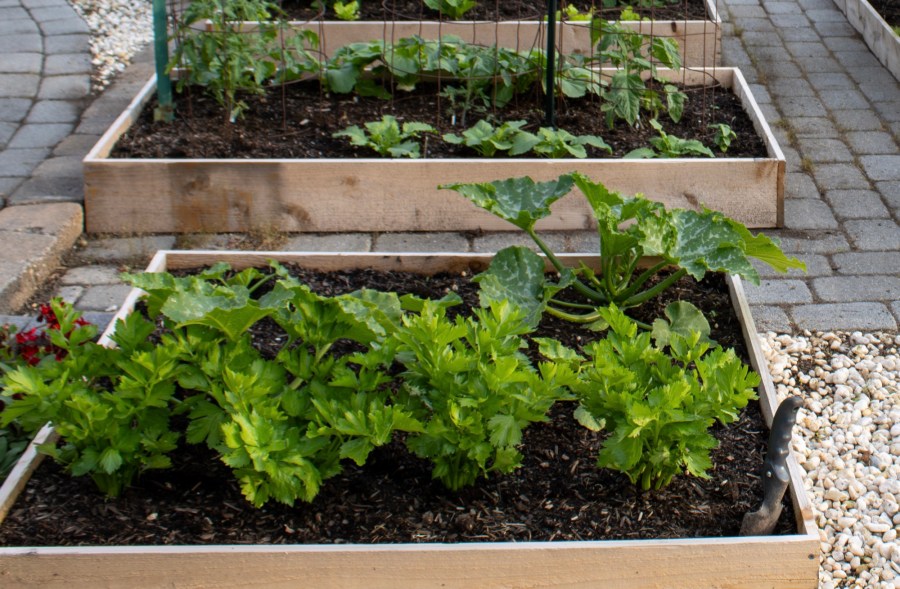
Is this a rant? Not really. An old person’s rambling eventually going nowhere? Quite possibly, but I’d like to think of it as a little discrepancy or a potential, dare I say, dichotomy I recently noticed regarding how we learn and identify natural foods.
Smidgen of a background. I have a vegetable garden and I’ve been gardening since I was 10. I’m keenly aware I have a fair amount of knowledge regarding those plants as opposed to the average person. I’ve also spent my life as a middle-class urban American on the Eastern Seaboard, so everything I’m about to spew out with moderate coherency is likely distorted by the lens of that culture.
On Tuesday, I was delighted – as always – to have some friends over for dinner. A few showed up a tiny bit early so we did a brief tour of my vegetable garden containing many classics such as, tomatoes, eggplants, peppers, zucchini, butternut squash, watermelon, cantaloupe, kale, chard, carrots, and green onions. We’re early in the season and many are not showing obvious fruit yet. Almost all of the questions I fielded were common ones I’ve answered for decades. Among them:
- What are those over there?
- Oh wow! This is a carrot?
- Is this a tomato plant?
- What is this? What is that? What are those?
Each I happily answered. Mind you, I don’t expect someone to tell a cantaloupe from a butternut squash being they’re closely related. But afterwards I’m often amazed that people can’t identify a tomato plant, nor a pepper plant. And one person being shocked upon recognizing a carrot after discovering the orange crown poking out of the soil, also surprises me.
And that’s when it hit me.
I don’t blame them in the least for lacking recognition of the plant form of fruits and vegetables they buy at the store. Whoever sees an eggplant’s leaves there? And why would they? I started thinking about how the average person (in these environs) learns about plant-based foods as children. We’re shown a drawing of an apple with the word ‘apple’. Ditto a tomato, or strawberry. Never the plant itself. Perhaps an apple tree, but then it’s just an amorphous green blob with some scattered red discs all perched atop a brown trunk. No details. As for leaf vegetables, well, almost never. Maybe spinach – once. Simply put, we’re only interested in the part that ends up on the dinner table, and the leafy stuff is barely recognizable by that stage (outside of lettuce in a salad, of course).
But that’s understandable and logical. Isn’t it? We’re just focusing on the most important part – the part we eat. Logical. Isn’t it?
This is where my mind immediately zeroed in on a contradiction to that “logic”. And here’s what popped into my mind: A “See ‘n Say” toy, but instead of images of the animals, there were images of what ends up on our plates. Pull the string as it’s pointing to bacon and you’ll hear “oink, oink, oink”. It seems we’re not learning the whole plant but we are learning the whole animal. And while kindergarteners can readily recognize and label drawn images of bacon, hamburgers, drumsticks, and shrimp; from what I’ve seen with (city folk) kids, they’re not necessarily making a connection between the food and the animal the food comes from. So why is this? Why the opposing treatments?
Don’t worry, I’m not going to get on a high horse about societal attitudes towards Veganism, animal treatment, etc. Well, maybe a little pony. There is no denying the cultural influence, but I would bet this viewpoint goes back a few generations prior and probably has more to do with the growth of mass production in addition to those attitudes regarding meat versus vegetables.
So from here on, this is all off the top of my head – all my opinion and from my experience. Hey, I may be talking through my hat.
With the rise of supermarkets and demise of small butchers and grocers, urban Americans have slowly divorced themselves from first-hand knowledge of the foods they eat. Meat items have been cut, sliced and cleanly packaged into cutlets and chops. You no longer have to kill your food, it’s done for you, allowing you to recoil over thought of killing a chicken while simultaneously stocking up on tons of wings for Super Bowl Sunday. Not getting up on that horse to judge, just saying. Also, you’ll never have to go in the field to raise and harvest, unless you’re a farmer. So the distance from plant to produce increases as well.
On the flipside, our educational system focuses more on animals than plants because, well, forgive me comic book’s Poison Ivy, but animals are more fun to learn about. They do things. We learn what they look like, where you find them, and how they act. These lessons have nothing to do with food. True fact, I was 8 when I saw my first elephant, yet 28 when I saw my first pig. It was never about the food.
Despite this, I still can’t see why when we’re taught about a vegetable, they don’t do it more holistically and learn about the plant. (Maybe they do now – I don’t have kids). I mean, we could. In fact, there is a glaring floral exception in America – corn. Show a corn stalk to children and they’re likely to identify it as quickly as an ear of corn (or pile of Green Giant niblets).
You may say, “Why bother? They’re just plants.” And I can answer that:
“Because.”
I’m also part Italian and one thing I learned about Italians from “the old country” is that they loved and knew their vegetables – root, stem, and all. That’s because many needed to grow their own and relative scarcity of meat meant a stronger reliance on plant-based foods to create a nutritious diet – the now famous Mediterranean Diet. It seems I may have inherited some of that veggie closeness and, quite honestly after 57 years of gardening, I feel much better for it.
So folks. If you have kids, maybe go the extra yard or two and teach them what the entire plants looks like to the point where they can identify them. Maybe, that might give them a closer connection to the food they eat that many seem to have lost.

 Richard L Pastore
Good gardening, and nice of you to not blame them for lacking recognition.
LikeLiked by 1 person
If I had to kill an animal before turning it into food, I’d definitely be a vegan!
Now that farmers’ markets are popular in cities, they might be a place to see some vegetables closer to their natural state. Or growing a few plants in pots and tubs.
LikeLiked by 1 person
Everybody needs an uncle Richard, a grandma, a sister, or that old neighbor who keeps a vegetable garden so we learn these things as we grow. My grandmother had an incredible garden in her back yard. Raspberry vines strung along the fence. Rhubarb over there. Tomatoes and everything else you could think of, including apricot, peach, and apple trees. Growing up, my sister was the keeper of the vegetable garden in our backyard. Having that in my past has led me to try to maintain a vegetable garden every year. A much smaller set of “the usual” than you plant — tomatoes, jalapeños, zucchini, basil and oregano, lemon cucumbers. I also have blackberry vines in another corner, a couple of peach trees, a lemon tree, and a tangerine tree.
I, too, would wonder, as a result, by people who wouldn’t recognize a tomato plant or a carrot growing out of the ground. Surely, they’ve had somebody in their life who planted a garden and exposed them to this stuff? Right?
LikeLiked by 1 person
A great point. I probably learned what some of the plants looked like when I was a kid because my father and grandfather both had gardens and grew tomatoes, beans and asparagus. But my more recent knowledge started when I started a garden with the kids and we watched everything grow. I was a complete gardening novice back then and learned after one season not to grow cucumbers in a flower bed on the side of the house – they took over the yard!
LikeLiked by 1 person