
Charting the Narrative of Your Story
As an artform, I love storytelling. It doesn’t matter if it’s written or oral, a saga or a short story. Whenever I think about a storyteller, I immediately conjure the image of a pre-civilization campfire where a group of nomads, sitting in rapt in attention, are listening to an elder relating a tale from their shared mythos. That love even affects my musical tastes keeping The Lumineers’ Cleopatra and Dire Strait’s Romeo and Juliet on my favorites list. Storytelling is my top motivator for writing as I do so love to tell a good story. I aspire both to craft a decent one and to relate it in the best way I can. And while elements such as character, plot, theme, and setting all contribute to the making of a good story; it is, in my opinion, the elements of rhythm and tempo which are the key subconscious contributors to good storytelling.
On the other hand, I also love the science. I’ve spent a significant portion of my life forming hypotheses, analyzing data, and reporting the findings. Some of you out there may lightly recoil at this next personal fact, but I actually enjoy spending time pouring over graphs and charts. In essence, they are attempts to translate complex information into easier to understand visual representations. At least that’s the hope. Like storytelling, it is an artform and there is certainly skill needed to do it well.
The idiosyncratically beautiful thing for me is there exists an intersection between those two areas: to wit, creating a visual representation for narrative structure. Generally speaking, the timeline of a narrative is presented on the horizontal x-axis while a narrative-related element is presented on the vertical y-axis. Some y-axis elements that I’ve come across are a character’s fortune, the level of tension on the part of the audience, and scene complexity. If you want to see a four-minute presentation on this topic, I recommend a short YouTube excerpt from one of Kurt Vonnegut’s lectures. The topic of the excerpt, The Shape of Stories is a favorite of Mr. Vonnegut’s – one he worked on for his master’s thesis. As an example, here is his shape of the Cinderella story:
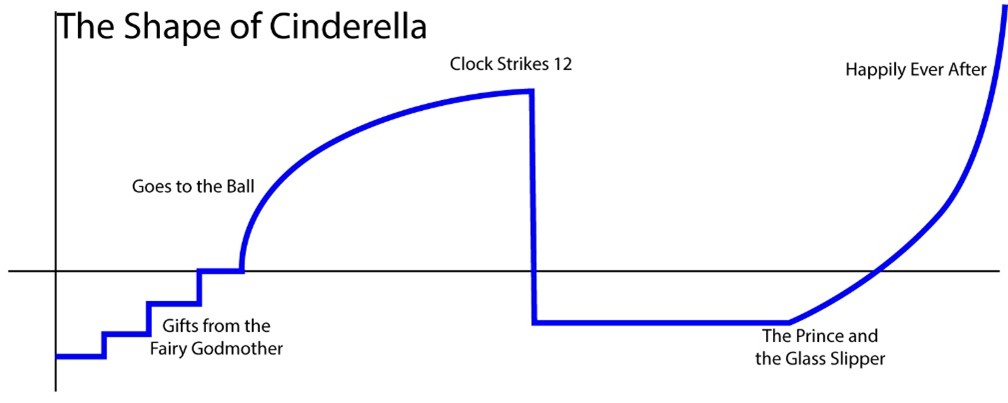
I should immediately point out, visual representations need not be limited to the lab coat stereotype that is a two-axes coordinate graph. Many representations I’ve come across are geometric in nature, employing shapes such as circles, triangles boxes, stars, and arrows. All together, they make fertile fodder for PowerPoint© enthusiasts.
But before getting to whether or not there is potential value in charting your narrative, we need to take a brief look at a jumping off point: narrative types.
Since the days of classic Hellenic philosophy, story structures have been analyzed in order to distill them down then compartmentalize them into basic types – as Aristotelians so passionately love to do with everything. I’m not knocking this process. The scientific portion of my mind has been keenly trained to do so. Atomization is core to the foundation of Western science. However, I’m also quite cognizant that while this process leads to insight and discovery, it does so at the sacrifice of a fuller context which is includes all of the outliers existing in so-called “grey areas,” – the land of the misfit toys. But for the purposes of this topic, let’s hold hands with the likes of Leibniz and skip down Monad Lane as we pigeon-hole narratives.
Here, I should level expectations. I’m not going to go into detail regarding a complete history of or an exhaustive list of narrative types simply because I want to avoid this post spiraling outward into a doctoral dissertation. I will throw a few darts on the board and if any of the names or terms I hit upon strike your fancy, feel free to do what authors tend to do best – research them.
So, starting with Aristotle, many analyses of narrative elements and plot structure focused on the path a plot takes across a set number of acts. Aristotle favored breaking down narratives into a three-act structure comprised of Set-up, Conflict, and Resolution.
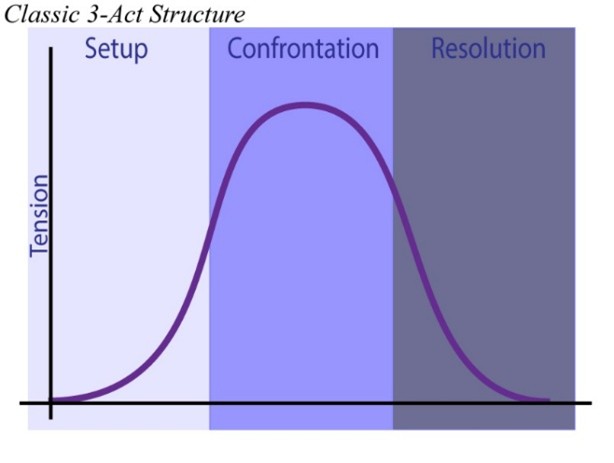
Joseph Campbell famously took this approach and adapted it to distill all myths into a monomyth called The Hero’s Journey, with the three acts forming the highest level of Departure, Initiation, and Return. Eastern narratives, on the other hand, favor a four-act structure consisting of Introduction, Development, Twist, and Conclusion (with regional variations).
Later, Gustav Freytag analysis led him to a five-act structure resulting in one of the first diagrammatic representations known as Freytag’s Pyramid, where Introduction leads to Rise, peaks at Climax, descends to Return/Fall and ends in Catastrophe/Resolution.
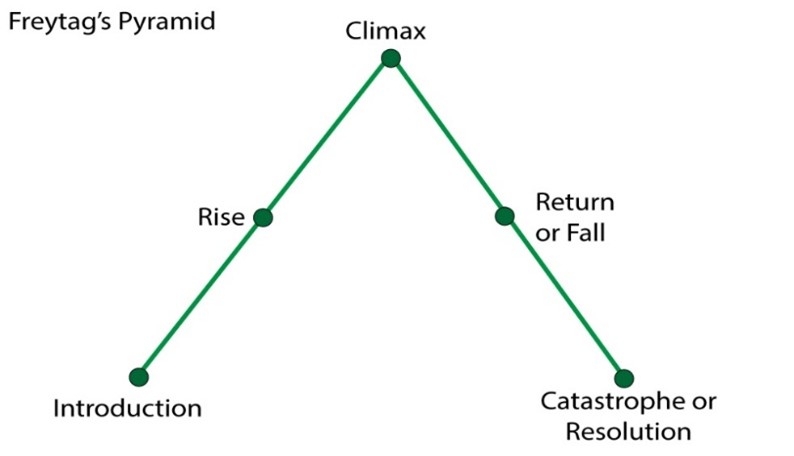
And it doesn’t end there. You can find breakdowns from seven acts to as many as twenty-three. I guess it depends on how thinly you want to slice your bologna. What they all have in common is the underlying assumption that a story will progress through stages where elements may rise or fall within any given stage. In Vonnegut’s lecture, he simplifies all acts into to a single line from Beginning to End.
What’s at the root of this division of acts along the timeline, is to provide a framework for the author to pivot up or down a step in tension, action, complexity, fortune, etc. As a Narrative Analyst (I just made that term up – I think), once you have decided on your X and Y framework, you can now go back, look at classic works – be they in book form or from the big screen – and start sorting them into “basic” types.
In his 2004 book, The Seven Basic Plots: Why We Tell Stories, Christopher Booker lays out seven core story types (pretty much self-explanatory):
- Overcoming the Monster
- Rags to Riches
- The Quest
- Voyage and Return
- Comedy
- Tragedy
- Rebirth
Although in my opinion, the Comedy and Tragedy types are his weakest categories, being over-generalized. I’ll point out a distinct type of comedy in a moment which illustrates my bias here. Closely related to Booker’s narrative bins is a 2016 study by Regan et al, which looked at emotional arcs of books, separating them into six basic types (Rags to Riches, Riches to Rags, Icarus, Cinderella, and Oedipus).
As a personal side note however, I bristle at statements such as “all stories can be classified into X types,” rather than a more realistic, “most stories can be classified into X types.” Again, grey areas exist.
So where does this all bring us? Why do I care? Is it worthwhile knowledge?
Well, to answer the last question, all knowledge is worthwhile. But for the first two, you just need a slight shift in perspective to see the relevance of numbers of acts and narrative types to the art of storytelling. Unless you’re looking to break the mold, storytelling relies on some very basic elements. The division of tales into acts, be it three, four, five, etc. is a way to set up a tempo – the beat. I would argue tempo is perhaps the most critical aspect of the art of storytelling. In fact, tempo is fundamental not just to the entire story arc but is so down to the levels of chapter and verse. A second critical feature for storytelling is rhythm, and rhythm is often derived from the narrative types such as the ones I’ve just glossed over. Looking at the types another way, if storytelling were a dance, a basic narrative type could be a waltz, or a line dance, or perhaps a spirited samba.
Fundamentally, I view storytelling as the ability to manipulate and direct the emotional state of an audience. And, while story elements such as characters and settings can engage and enchant the audience, they work at the cerebral, conscious level. It is rhythm and tempo which entice the primitive, subconscious mind just as it does in music and dance.
Let me give you an example of this from the Comedy genre: the farce, which I alluded to being glossed over in Booker’s narrative types. A farce is a specific comedic tale which relies on an ever-increasing emotional tempo. Oddly enough, its closest relative is the “non-stop action” story – I guess the “Fastest and Furiousest” ones. If you wished to graph a farce, it would look like the side view of a steep staircase. We start at step one where each successive step narrows and heightens, increasing the tension – and theoretically, the ensuing hilarity – ending at a crescendo where you fall off the topmost step back to the ground.
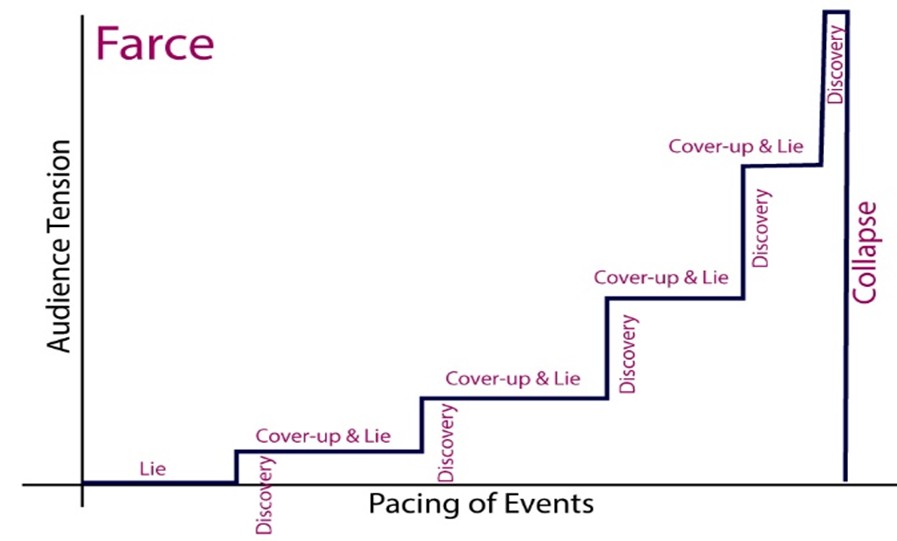
If you have ever seen any episode of Fawlty Towers, you have a classic example of a farce. Basil tells a lie to Sybil, then needs to cover for the lie, leading to another lie, leading to ever increasing plot complexities until it all collapses. As an author or screenwriter, for rhythm, this image of a staircase may be useful. Specifically, it’s not a ramp. You need to allow the audience moments to laugh, inhale, and anticipate before taking another step up.
In many farces, the progression tends to be exponential as I’ve shown above, with the height of each step (audience tension) increasing while the width (time for plot events) decreases. Tempo, the width of each step, is the breather allowing the audience to relax and the plot to move forward towards the next set-up. An important thing to keep in mind with an increasing tempo is there is a limit before audience fatigue sets in. If you are crafting a farce which is very intense and very brisk (narrow steps) it will likely need to be short in length.
So here, with rhythm and tempo, we have one reason to consider the shape of your story. Do you need to physically draw it? Nah. I mean, it could be an interesting and fun exercise, but I think at least an awareness of your tale’s structure at some point in your process between inception and final revision wouldn’t hurt.
Now that we’ve seen the potential of charting your narrative from this viewpoint, I’d like to bring up a second potential benefit: visualizing the organization of your story arcs.
One trend I’ve noticed in 21st century cinema and literature is the increasing use of a grand arc over multiple books, episodes, and movies allowing what would have been major plots to be redefined into detailed sub-plots. Coincidentally, there’s also been an increase in the audience desire for plot continuity. Wilma Flintstone’s maiden name varied, yet every detail of Marge Simpson’s life is remarkably consistent – for over 35 years despite the characters remaining the same age. (A situation I surmise can be explained only within the realm of Einstein’s theory of General Relativity).
As a result of this trend, many authors and screenwriters who are pursuing the super-arc style need to carefully layout story arcs and timelines. As a further result, there are growing numbers of studies, books, and articles related to charting narrative plots to assist with this. As an even further result, more apps are incorporating charting tools in order to do so. Dominos.
Of course, not everyone is attempting to write a novel with the rich complexity of Beethoven’s Ninth Symphony. Many are striving for the simple elegance of David Bowie’s Heroes. Every author I’ve ever met has their own way of writing. If you are one, I also can’t imagine you escaping the dreaded forced-choice plotter/pantser question. However, it would be remiss of me to ignore this distinction if I’m going to make any claim as to the potential of mapping out your plots.
So, perhaps you’re the type of author who sees yourself as a hiker stumbling across a path and wondering wither it may lead. (Personal note: this is precisely how I got lost for over two hours in Stanley Park during my visit to Vancouver). For the hiker, the chart is only viewable after your journey is complete, providing little or no significant use. So, you’d probably find this topic of interest only out of intellectual curiosity.
But then again, maybe you’re on the other end of the spectrum, carefully laying out each detail before the first sentence of your tale has been constructed. In that case, you’ve probably been charting your plots long before you read this post. There’s a chance you may be using one of those apps to help organize your story arcs.
However, perhaps you’re somewhere in between. In that case, a little charting may be useful. It might help keep your storyline from spiraling out of control, or it might help you target a plot point you’re attempting to reach from where you currently are. Whichever is your case, I’d like to end off with an example of how I used plot charting for my book, The Devil and the Wolf.
The need for a visual arose once I decided to have a sub-plot arc for each of the major groups involved (Angels, Devils, Humans). To add to the complexity, I also decided to remove all reader insight into the mind of the main character (Mephistopheles). Doing so intentionally kept the primary arc unknown. The reader might be assuming progress, but would remain unaware if he were truly succeeding or failing in his objectives. By having to lean heavily on the three subplots, I was essentially allowing them to determine the tempo and pacing. I figured a basic visual aid would be a useful reference guide as I wrote through all of the chapters.
Having three subplots and a host of characters motivated me to keep those plots simplistic in design and (subconsciously) recognizable. Therefore, I used a classic villain’s arc for each which is fundamentally Vonnegut’s Man in a Hole, but tacks on a final failure. (Until next time, Mr. Bond). What I specifically wanted to avoid was the contemporary grand-arc multi-plot design, because nearly all rely on all plotlines converging in a cataclysmic denouement.
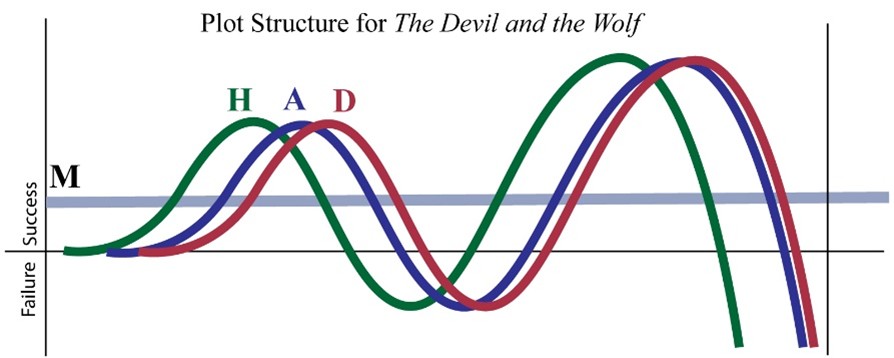
In my mind I sketched something akin to what you see here. The four lines are labeled M (Mephistopheles, true motives unknown), H (Human, Connie & Dale Carina), A (Angels, Eremiel), and D (Devils, Nergal).
I cannot understate how important this simple image was while I worked through my chapters. It was my roadmap to keep me on track and give me a sense of pacing. For example, I knew I wanted some space between the Human finale and the others, but closeness between the Angel and Devil finales. Since the book is on the longish side, my hope was that these variations would help increase the pacing needed to keep a reader’s attention towards the end. Also, the Mephistopheles line continued past all of the finales in order to give a “well that wraps up everything neatly” feel before I reveal an additional level to his onion-esque motivations.
And so that’s it. End of post. As I mentioned earlier, there’s a growing amount of information on the charting and categorization of narrative structure. If you do decide to research this topic, I add the standard warning of avoiding anyone who claims a specific narrative structure will guarantee big sales. While it’s quite true some narrative types are more popular than others, they are not guarantees of success. What I will say, is what I repeatedly have said: Do whatever works for you and use whichever tools help you achieve your writing goals. Perhaps a plot chart might simply be one more tool in the box.


I guess I’m like your hiker picking paths without any definite route in mind. (Didn’t know you got lost in Stanley Park; it’s been decades since I did that!) I rely on the internal logic of my story’s world and fumble my way through the first draft. I make some adjustments in subsequent drafts, but I have to admit I never think about any of the named story structures even then.
LikeLiked by 1 person
I was in Vancouver for a conference and thought a nice half-hour stroll through the park after lunch would be in order. At one point I thought I was on the correct track, but I ended up hundreds of feet above whatever main route cuts through it. 😂
LikeLike